Bangalore doesn’t need an introduction as India’s tech capital, but it does need a reality check: the city that builds the world’s software is now racing to reskill its own workforce for AI. Global capability centres, product startups, and IT majors are all hunting for the same small pool of AI-ready talent, and most of them are hiring from the same few zip codes around Whitefield, Marathahalli, and Koramangala.
Here’s the number that should make you pause: NASSCOM projects AI-related job demand in India will cross 1 million by 2026, but only around 16% of IT professionals are currently AI-skilled. That’s not a small gap. It’s the reason recruiters are messaging strangers on LinkedIn and the reason “I know Python” no longer counts as an AI skill on a resume.
Bangalore sits at the centre of this shift. The city accounts for roughly 11% of India’s AI job postings, the largest share of any Indian city, and its tech workforce has crossed one million people, making it one of the largest technology labour markets in the world. If you’re going to learn AI anywhere in India, this is the city where that skill gets tested, hired, and paid for immediately.
Pay reflects the demand. As of mid-2026, the average AI engineer salary in Bengaluru ranges roughly between ₹15.8 LPA and ₹43.8 LPA, and freshers typically start between ₹6.5 LPA and ₹9 LPA. Senior specialists in NLP, computer vision, or MLOps command significantly more — some profiles on niche salary trackers show experienced AI engineers in Bengaluru crossing ₹40–50 LPA. These are approximate, self-reported figures that shift with company, specialisation, and negotiation, but the direction is unmistakable: AI skills pay a real premium over standard software roles in this city.

So who should actually be reading this guide? If you fall into any of these buckets, keep going:
- Students and fresh graduates who want their first job to be an AI job, not a “we’ll get to AI eventually” job
- Working software engineers who write code every day but have never touched a model in production
- Data analysts who want to move from reporting numbers to building the systems that generate them
- Career switchers from non-tech backgrounds who’ve watched AI reshape every industry and don’t want to watch from the sidelines
- Entrepreneurs and business owners who need to understand AI well enough to make smart build-vs-buy decisions
- Managers who don’t need to code but do need to speak the language fluently enough to lead AI-adjacent teams
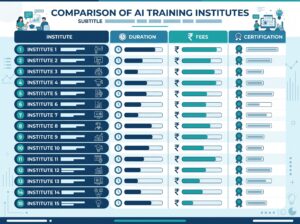
This guide breaks down the 15 most credible AI courses available in Bangalore with certification in 2026 — what they actually teach, what they cost, who they’re built for, and how to tell a genuinely good program from a marketing page with a countdown timer on it.
Why Learn Artificial Intelligence in 2026?
If you’ve been on the fence about learning AI, 2026 is a strange year to keep sitting there. Here’s what’s actually happening in the market right now.
Industry growth is not slowing down
The Indian AI software and services market is expected to grow at a 25–35% CAGR through 2027. That’s not hype-cycle growth. That’s enterprise budgets being reallocated, quarter after quarter, toward AI infrastructure and talent. NASSCOM’s AI Adoption Index puts India at 2.45 out of 4, with 87% of enterprises already using AI in some form as of December 2025, and 88% of surveyed organisations report using AI in at least one business function.
Hiring trends favour AI skills specifically
AI professional demand is projected to exceed 1 million roles in India by 2026, with the talent pool potentially reaching 1.25 million by 2027 — but supply is growing at roughly 15% a year against 25% demand growth, which keeps widening the gap. On the hiring-activity side, LinkedIn’s 2026 AI Labour Market Report found AI engineering job postings in India grew 59.5% year-on-year — the fastest growth rate among major global markets, ahead of the US, UK, France, and Germany.
Salary statistics back it up
Multiple salary trackers converge on a similar picture: fresher AI engineers in India typically start between ₹5–8 lakh per year, while mid-career professionals earn ₹15–30 LPA and senior AI engineers earn ₹30–60 LPA. In Bangalore specifically, average AI engineer salaries sit around ₹25.9 lakh, roughly 14% above the national average, and the AI-versus-software-engineer salary premium runs 15–20% at entry level, widening to 30–40% at senior levels. These figures are approximate and vary widely by company and specialisation, but the pattern is consistent everywhere: AI skills earn more than adjacent software roles.
Future opportunities are broadening, not narrowing
AI hiring used to mean “a handful of research labs.” Not anymore. AI and machine learning roles grew 25% across 14 industries tracked in recent reporting — finance, healthcare, retail, manufacturing, and logistics are all building AI teams now, not just tech-first companies.
AI adoption is now a business-wide expectation
Boards and CEOs aren’t asking “should we use AI” anymore — they’re asking “why haven’t we deployed it yet.” That shift changes who needs AI literacy. It’s no longer just engineers; it’s product managers, marketers, operations leads, and business owners who need enough fluency to direct AI initiatives even if they never write a line of Python.
Business demand is creating new job categories entirely
Roles like Prompt Engineer, AI Product Manager, and Generative AI Specialist barely existed three years ago. They exist now because businesses need people who understand both the technology and the commercial problem it’s solving — a combination most traditional computer science degrees don’t teach.

How to Choose the Best AI Course
Fifteen institutes, a dozen course formats, and fee ranges from ₹15,000 to over ₹3 lakh — how do you actually pick? Run every shortlisted course through this checklist before you pay a rupee.
Curriculum. Does it go beyond “Python and basic ML” into the stuff employers are actually hiring for in 2026 — LLMs, prompt engineering, RAG (retrieval-augmented generation), vector databases, and AI agents? A curriculum that hasn’t been updated since 2022 is a red flag.
Faculty. Are instructors practitioners who’ve shipped AI systems, or are they full-time trainers who’ve never worked in industry? Both can teach well, but practitioner-led courses tend to carry more real-world nuance.
Projects. Look for capstone projects that mirror actual business problems — fraud detection, recommendation engines, chatbots, computer vision pipelines — not toy datasets you could finish in an afternoon on Kaggle.
Internships. Not every course offers this, but if you’re a student or early-career switcher, an internship component is worth paying a premium for.
Placement support. Ask specifically: is it “job assistance” (resume help, interview prep, some referrals) or genuine placement guarantees with hiring partners? The difference in language usually reflects the difference in outcome.
Certification. A university-backed or globally recognised certificate (IIIT, IISc, an international university partnership) generally carries more weight with recruiters than an in-house certificate from a training company — though both can be legitimate depending on your goals.
Industry partnerships. Courses built with input from hiring companies tend to stay more current and often come with direct hiring pipelines.
Hands-on learning. AI is a build-it-to-understand-it subject. If a course is 80% lecture and 20% practice, walk away.
Online vs offline. Offline classroom training in Bangalore suits people who learn better with in-person accountability and networking. Online (self-paced or live) suits working professionals who need flexibility. Weekend batches are a popular middle ground for people already employed full-time.
Fees. Don’t just compare the sticker price — compare fee per hour of actual instruction, and check what’s included (projects, mentorship, placement support, certification exam fees).
Duration. Shorter isn’t always better. A rushed 6-week “AI mastery” course won’t get you interview-ready for a ₹15+ LPA role. Serious programs generally run 4–13 months.